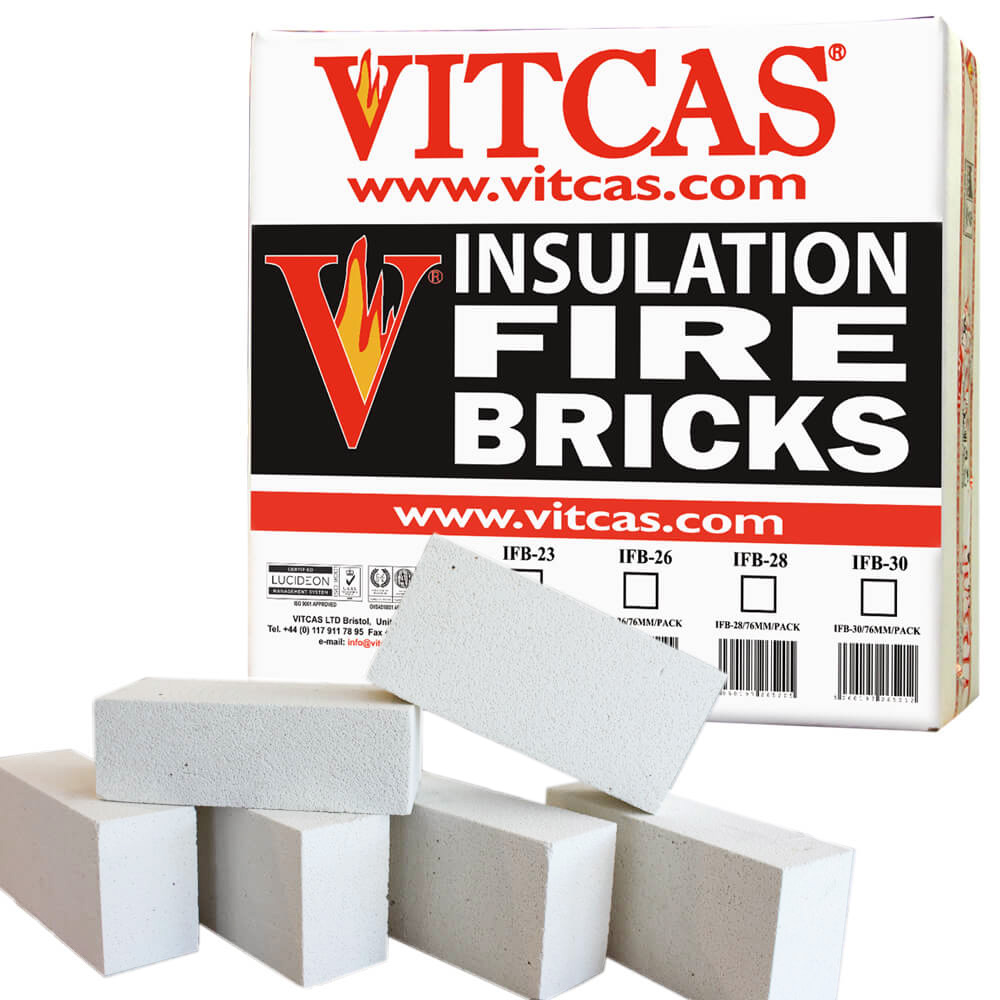
Lightweight insulating bricks and heavy refractory bricks can withstand high temperatures, yet they are not interchangeable. The former limits heat flow and the amount of energy stored in the lining. The latter can create a more mechanically resistant, heat-storing working layer. In a DIY oven, choose the function before comparing the price per piece.
Determine whether you want to store heat
Vitcas Grade 23 insulating bricks have a porous, lightweight structure and a declared resistance up to 1260°C. The manufacturer describes their use in appropriate furnaces and high-temperature devices. The lower mass of the lining behaves differently than a heavy wall intended for later heat release.
If, after finishing firing, you plan to use the heated chamber, simply reducing the mass does not always achieve this goal. Consider Vitcas dense firebricks for a compatible working and heat-storage layer. The system can combine both functions in different locations.
Check load and abrasion
Lightweight brick has lower resistance to pressure, impact, and abrasion than properly selected dense refractory material. Areas exposed to fuel handling, heavy components or tools need a separate assessment. A light colour is not a sufficient selection criterion.
In the project, indicate whether the insulating brick will be an exposed working surface or a layer beneath another lining. Choose the type according to the temperature at that location, the device's atmosphere, and the material of the joints. Do not assume that any mortar fits any porous brick.
Compare the complete cross-section
- Function and position of the light and heavy layer.
- Weight, support, and method of fastening adjacent elements.
- Temperature, exposure to wear, and protection conditions.
- Requirements for joints, cutting, and initial heating.
After such an evaluation, it is possible to order a specific variant instead of a material specified only as brick for a heating appliance. Keep the product designation so that a later replacement does not change the function of the lining.